Why white papers belong in your climate tech content strategy
Your buyers are sceptical, stretched across buying committees and driven by different priorities when purchasing high-stakes climate tech. White papers give them the depth and evidence they need to say yes.
Jat Leng Low
7 min read
Your prospects are sceptical. They won’t easily trust your climate solution.
Not when they’ve been burnt – by greenwashing claims that weren’t backed by evidence, and by technical complexity that didn’t give them a clear picture of what they’re actually buying.
So they’re finding strength in numbers – buying committees where the CFO, the sustainability lead and the procurement manager all need to be convinced. They each want different things, whether it’s ROI, sustainability outcomes or lower vendor risk.
And as the marketer, you’re the one who has to produce content that speaks to all of them clearly and credibly – without your salespeople in the room.
Yep, it’s complicated.
That's where white papers come in.
In this post, I’ll share why you need white papers in your content strategy.
Why your buyers are harder to reach than ever
The buyer you have to market and sell to is no longer just the sustainability lead.
According to Demandbase’s Understanding the State of the B2B Buyer report, 72% of B2B purchases involve complex buying committees. These buyer groups often include 7 to 10 stakeholders from different teams, such as operations, IT, finance and end users.
This trend is also seen in climate tech buying. Kate Taylor, Director of GTM at Abatable, interviewed in the Climate Tech Marketing in 2026 report by The Climate Hub, says: “The CSO as the ‘main buyer’ of carbon credits has traditionally reported into a couple of different avenues. These could be the CRO, the COO, even the CEO …
"But now there are other players to consider – finance, legal and compliance team members – which opens up a whole new set of pain points, languages, skillsets and even personalities to cater to as marketers.”
Carole Zibi, Vice President of Marketing at Plan A, shares a similar view in the same report: “The climate tech buyer has been more integrated into operations and finance in the last year … a few years ago, only one or two people might have been involved in the purchasing decision, now the buyer’s group is larger.”
Harness the power of social media, too: not only can you easily talk back and forth with your audience, but it’s also a great tool for marketing.
When you’re setting up your social media accounts, check that you can use the same or a very similar version of your website’s domain as your account handle. This will make it easier for your audience to remember you, no matter which platform you’re using.
Demandbase’s Understanding the State of the B2B Buyer and The Climate Hub’s Climate Tech Marketing in 2026 report indicate that large and diverse buying committees are involved in purchasing decisions. (Sources: Demandbase, The Climate Hub)
It’s not just who’s buying that has shifted. How they buy has changed as well. The 2025 B2B Buyer Experience by 6sense reports that:
Buyers shortlist an average of 5 vendors before reaching out to them.
The final winner is almost always a vendor from this preliminary list (95% of the time).
The final winner is often the preferred vendor that the buyers have already chosen at the shortlisting stage (77% of the time).
What does this all mean for you?
Consensus on what to buy is harder to achieve
Buying committees comprise stakeholders from multiple departments and seniority levels. They bring different priorities and varying levels of climate fluency to the table. Getting everyone to agree on the problem – and the solution – is hard.
You’re in the conversation only if you’re in the shortlist
To get a realistic shot at winning the deal, you need to make it into the shortlist in the first place. (Even then, non-preferred vendors manage to flip the decision only 20% of the time.)
Your content does the selling before your salespeople are
Buyers research solutions on their own without reaching out to vendors. They rely on social media, AI tools, online reviews and peer recommendations to narrow their options. And they also use vendor content – yours and your competitors’ – to help define their problems and frame their questions, well before salespeople enter the picture.
Not all content can do that work.
Social posts, videos and blogs do important work attracting attention and building awareness. But such shorter content can’t offer the depth your buyers need to understand concepts and define problems before considering solutions.
In the Content Marketing Institute’s B2B Content Marketing Benchmarks, Budgets and Trends: Outlook for 2024report, 51% of the B2B marketers surveyed chose thought leadership ebooks or white papers as the third-most effective content type delivering the best results.
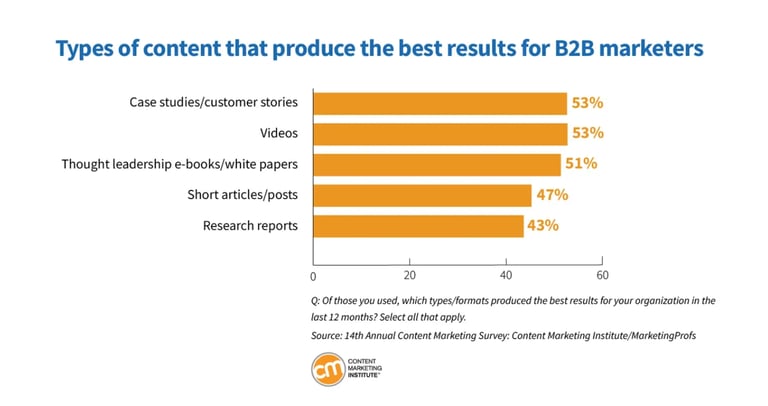
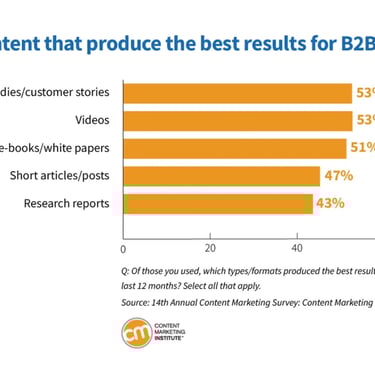
More than half of the B2B marketers surveyed by CMI considered thought leadership white papers and ebooks to be effective content formats. (Source: CMI’s B2B Content Marketing Benchmarks, Budgets and Trends: Outlook for 2024)
The reason is straightforward: White papers help you sell when you’re not in the room and build trust before sales conversations begin.
Why climate tech companies need white papers
White papers educate your buyers
Climate tech buying committees are large and diverse. Each stakeholder has different concerns and goals, not to mention varying levels of technical and climate literacy. Within the buying committee, they play various roles. Some are technical evaluators or budget controllers. Others are the end users or final decision-makers.
For example, for a prospective company seeking carbon accounting software, its buyer group may include:
The sustainability lead, who is the most technically savvy and demanding. They want solid proof that the vendor’s claims aren’t greenwashing. They ask questions like: Where do your emissions factors come from, and are they updated regularly? Which scope 3 categories are covered? What reporting frameworks does the software support?
The finance VP, who needs to walk into the CFO’s office with a clear business case. They want to know: What are the cost savings? How much risk does this mitigate? What is the ROI?
The procurement manager, who needs to be sure that the risks of buying the solution (e.g. vendor stability, data security, implementation, compliance) are low. So, they ask for track records, case studies and documented outcomes.
They all need to say yes. That’s why you need a content format that provides sufficient depth to speak to and build trust with multiple stakeholders simultaneously.
In other words: white papers.
White papers break down complexity
Climate tech is technically complex. From emissions scopes to carbon accounting methods, from carbon credits to regulatory requirements, the learning curve is steep for anyone whose day job isn’t sustainability.
White papers are built for this. When done right, they are in-depth but always clear and jargon-free, breaking down complex topics in plain language.
They carry insights backed by research and verifiable data, so your buyers can evaluate and trust that your product, service, or method is the solution to their specific problem. Such data often comes from case studies, original research, industry reports and surveys.
White papers build trust before your sales conversations begin
Climate solutions often feel intangible. From carbon accounting software to carbon offsets, buyers don’t get to see what they’re going to buy or truly understand its value before committing.
Climate solutions aren’t impulse buys, either. The risks of purchase are high, from non-compliance penalties to financial loss, operational disruption to reputational damage. Buying committees are careful in selecting options that seem credible.
Well-researched, data-driven and rigorously executed white papers are trust signals. They help you make the abstract concrete and claims credible by using evidence – cited research, documented data and real-world case studies.
Take reporting requirements, for example. The regulatory environment is constantly shifting. If your white paper can help buyers understand the shifting compliance implications, it isn’t just marketing collateral. It is also a genuinely useful reference that buyers want to download and pass around.
In their minds, you become a dependable vendor that understands their needs and can help them achieve their decarbonisation and climate goals.
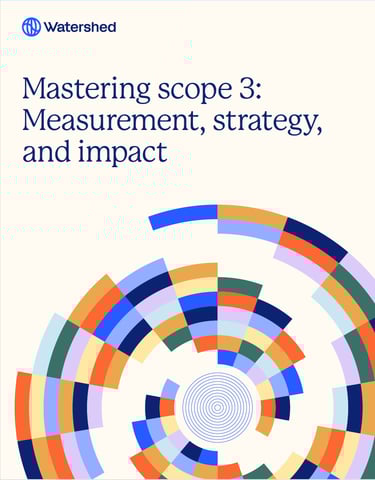

Watershed’s Mastering Scope 3 guide helps its prospects understand the why, what and how of Scope 3 emissions reporting – a useful reference that’s shareable among stakeholders.
White papers are shared when your salespeople are not in the room
Here’s something worth remembering: stakeholders circulate content among themselves. The sustainability lead may forward your white paper to the CFO or share it in a Slack channel you’ll never see.
White papers do the selling without you or your team present by providing substantial information supported by research and data to answer your buyers’ questions and address their objections.
Demand Gen Report’s Content Preferences Survey 2023 corroborates this: More than half of the buyers surveyed said they’re more likely to share content with the buying committee, or contact sales, if it’s supported by data.
It’s easy to think that time-poor, attention-stretched buyers always prefer short-form content such as social posts, quick reels and snappy blog posts.
That’s not wrong.
But serious buyers still turn to long-form white papers. And especially for climate tech buying, white papers are indispensable.
Your buyers are researching solutions and circulating content. You want a seat at their table right now – before they reach out to other vendors in their shortlist.
White papers help buyers understand the problem and evaluate options. They build buyers’ trust in your solution and shape the internal case for it.
By investing in depth and substance, you give your buyers the confidence to move forward with you.